Kiteworks Lifts Precautionary Server Shutdown Following Federal Intelligence Warning Regarding Critical Vulnerability

American technology firm Kiteworks has officially rescinded its emergency directive for customers to power down their infrastructure after the company successfully patched a critical vulnerability that had prompted an urgent, high-stakes security response. The company, which specializes in secure file-sharing and content governance, had issued the unprecedented instruction on Saturday following a credible warning from federal intelligence authorities regarding the potential for an imminent zero-day exploitation attempt. By Monday, the company confirmed that all hosted customer environments had been brought back online, citing a lack of evidence regarding any compromise or malicious activity during the incident window.
Kiteworks, formerly known as Accellion, operates a sophisticated Private Content Network (PCN) that serves as a central hub for thousands of global enterprises and government agencies. Its platform integrates Managed File Transfer (MFT), secure email, API-driven workflows, and web forms into a single, highly regulated ecosystem. With a user base exceeding 100 million individuals, the company represents a high-value target for threat actors, as the information passing through its servers is often classified, proprietary, or subject to strict data privacy regulations.
A Chronology of the Emergency Response
The events leading up to the resolution began late last week when Kiteworks received intelligence reports concerning a potential zero-day vulnerability in its software stack. Recognizing the gravity of the threat and the potential for large-scale data exfiltration, the company initiated a proactive defense strategy.
On Saturday, September 26, Kiteworks issued a global alert to its client base. The instruction was clear and immediate: administrators were advised to temporarily shut down all Kiteworks servers to effectively isolate them from the internet, thereby neutralizing the threat of remote exploitation while the company’s internal security teams worked to develop and deploy a patch.
Throughout the weekend, a period of heightened tension for the cybersecurity industry, the company’s engineers worked around the clock. By Monday, September 28, the company concluded its incident response cycle. In an official communication to its stakeholders, the company stated, "Continuous monitoring throughout the period showed no abnormal activity, and the company has no indication that any Kiteworks or customer system was compromised." Following this verification, the shutdown recommendation was formally lifted, and clients were authorized to bring their infrastructure back online.
Technical Details and Scope of the Patch
The vulnerability identified by the company was isolated to a specific feature within the Kiteworks platform—the Kiteworks Advanced Forms component. According to the company’s technical briefing, this feature is utilized by less than 1% of the total customer base, significantly narrowing the blast radius of the potential exploit.
To address the flaw, Kiteworks developed an emergency software fix during the shutdown window. Furthermore, as an additional layer of security, the company deployed a protective patch across all global environments, regardless of whether a specific client was utilizing the vulnerable feature. This "defense-in-depth" approach ensured that even if an attacker had attempted to weaponize the vulnerability, they would have been thwarted by the broader infrastructure hardening.
As of this writing, Kiteworks has not yet assigned a Common Vulnerabilities and Exposures (CVE) ID to the incident, nor have they released a granular technical breakdown of the vulnerability. This is common practice in the early stages of incident response to prevent threat actors from reverse-engineering the patch before all affected customers have had the opportunity to update their systems.
The Threat Landscape: Why File-Sharing Platforms Are Targets
The decision by Kiteworks to trigger a full-scale shutdown was influenced by the historical context of the file-sharing sector. These platforms are prime targets for cybercrime syndicates because they serve as the "digital pipelines" for sensitive corporate data. When a vulnerability is discovered, it is often a race against time between the security vendors patching the hole and threat actors weaponizing it for extortion.
This reality is underscored by the history of the company’s predecessor, Accellion. In 2021, the company was the target of a major campaign orchestrated by the Clop ransomware gang. That incident exploited a vulnerability in the legacy File Transfer Appliance (FTA) software. At the time, approximately 300 customers were using the legacy system, and the resulting breaches affected high-profile entities across the globe.
The Clop campaign of 2021 was a watershed moment for data security. It resulted in the unauthorized access of sensitive files held by major corporations and government bodies, including the Reserve Bank of New Zealand, energy giant Shell, and the cybersecurity firm Qualys. The incident was so significant that the Five Eyes intelligence alliance—comprising the United States, United Kingdom, Canada, Australia, and New Zealand—issued a joint security advisory urging organizations to abandon the legacy FTA software entirely. That historical trauma likely informed the cautious, proactive stance taken by Kiteworks leadership during this latest security event.
Industry Visibility and Vulnerability Exposure
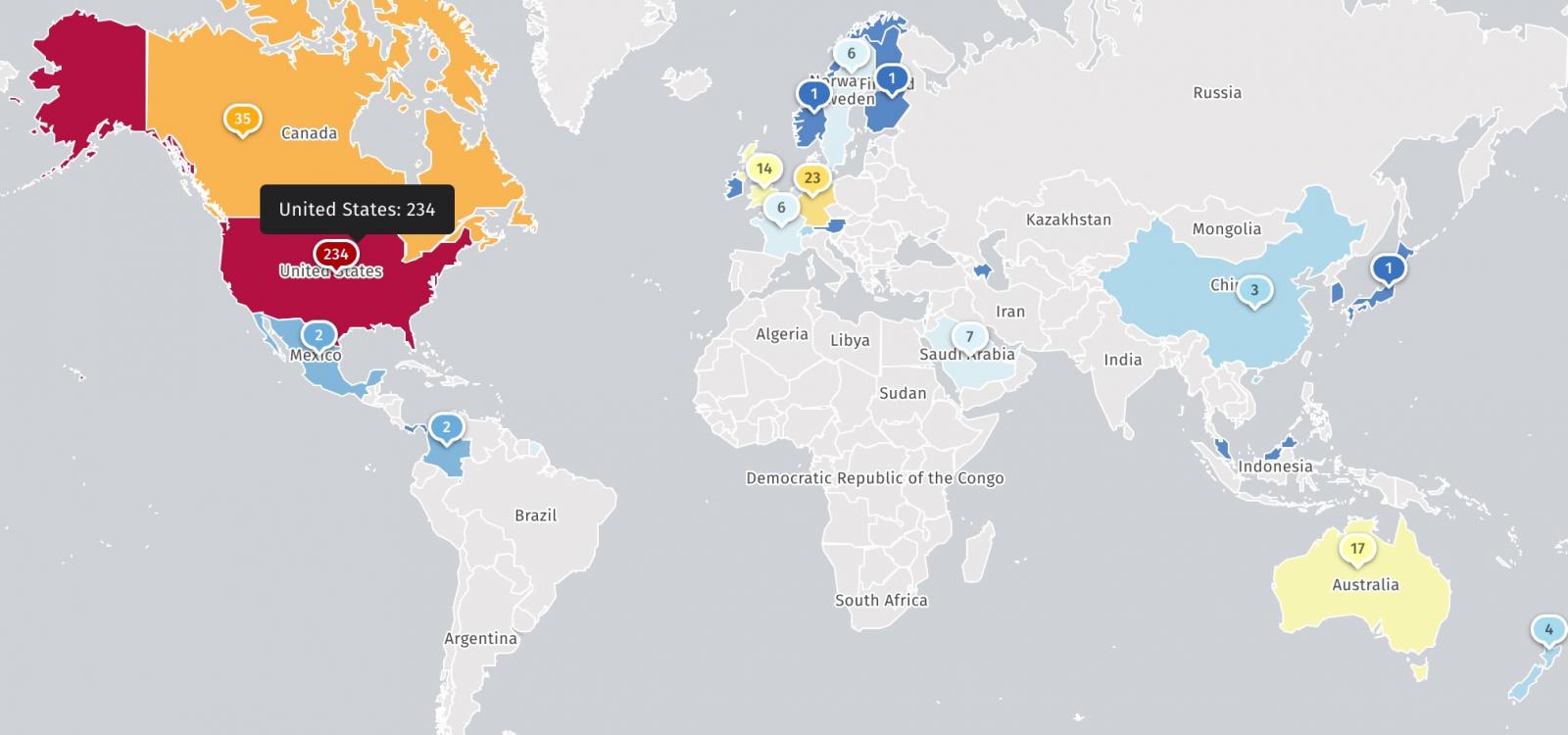
The potential risk during this latest incident was exacerbated by the number of instances visible to the public internet. The threat intelligence watchdog Shadowserver, which continuously scans the IPv4 address space for vulnerable services, identified nearly 400 active Kiteworks instances accessible globally.
Of these, 234 were traced to IP addresses within the United States. While the visibility of a server on the internet does not automatically equate to it being vulnerable, it does provide a roadmap for attackers conducting reconnaissance. The ability of researchers to pinpoint these instances illustrates the challenges of modern perimeter defense. Even if a system is not currently compromised, the mere accessibility of the login page or the API endpoint allows for automated "brute-force" or "fuzzing" attacks.
While the majority of these instances are likely legitimate enterprise deployments, the presence of such a high number of public-facing endpoints explains the urgency of the intelligence community’s warning. If a zero-day exploit had become public knowledge before the patch was applied, the potential for a mass-scale breach would have been extreme.
Implications for Enterprise Security
The successful handling of this event highlights a shift in how modern software-as-a-service (SaaS) and managed service providers handle risk. In the past, companies might have attempted to "quietly" fix a vulnerability to avoid reputational damage. The Kiteworks approach—a transparent, high-urgency, and proactive shutdown—demonstrates a commitment to prioritizing customer data integrity over the short-term optics of a service interruption.
However, the incident also raises broader questions for organizations that rely on third-party vendors for sensitive data transfer. Security analysts emphasize three critical takeaways from this event:
- Vendor Risk Management: Organizations must have a robust incident response plan that accounts for their supply chain. When a vendor issues an emergency shutdown order, the client must be able to act immediately without causing significant operational paralysis.
- Asset Visibility: The Shadowserver data confirms that many organizations may have "shadow IT" instances—servers that are exposed to the internet without the central IT department’s full oversight. Maintaining an accurate inventory of all internet-facing assets is essential for minimizing the attack surface.
- Proactive Defense: The fact that Kiteworks was able to prevent exploitation through a rapid patching cycle and proactive communication suggests that the "responsible disclosure" model is working. The collaboration between intelligence agencies and private industry remains the most effective tool for mitigating the impact of zero-day threats.
As the digital landscape becomes increasingly complex, the reliance on centralized file-transfer platforms will continue to grow. While the risk of compromise remains a permanent feature of the modern internet, the ability of organizations like Kiteworks to contain, patch, and recover within a 72-hour window provides a template for how the industry might survive the next wave of sophisticated, AI-speed cyberattacks. For now, the threat has been neutralized, but the incident serves as a stark reminder that in the realm of global data exchange, security is not a static state, but a continuous process of vigilance, verification, and rapid adaptation.
Related posts: